
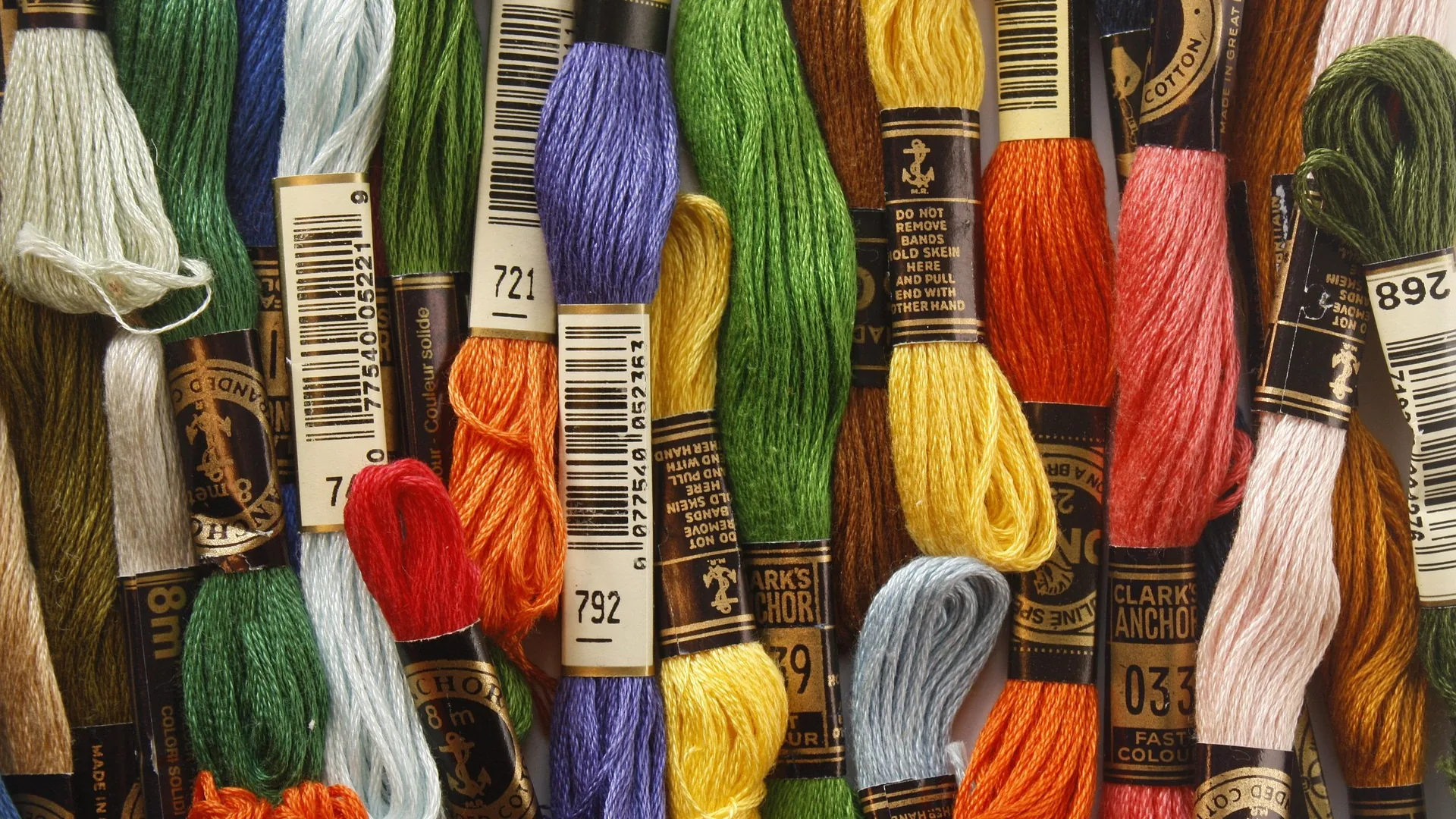
DMC, Anchor and Madeira: A Guide to Cross Stitch Thread
The thread you stitch with has a big say in how your finished piece looks and feels. Most cross stitch is worked in stranded cotton, and three names come up again and again: DMC, Anchor and Madeira. If you have ever wondered what the difference is, or how to swap a pattern from one brand to another, this guide is for you.
What stranded cotton is
Stranded cotton, sometimes called embroidery floss, is a soft thread made of six fine strands loosely twisted together. You rarely stitch with all six. Instead you separate the strands and use one, two or three depending on your fabric and the effect you want. Our guide on how many strands to use covers that in detail.
The thread comes wound in a small bundle called a skein, usually about eight metres long, held together by two paper bands printed with the brand and shade number.
DMC
DMC is the most widely used brand in the world, and the one most patterns are written for. Its range is enormous, its colours are consistent from skein to skein, and it is stocked almost everywhere.
- Numbering: each shade has a number, such as 310 for black or 815 for a deep red
- Why people choose it: availability, a huge colour range, and the fact that most charts list DMC numbers by default
If you are starting out and following a pattern, DMC is the safest default because the shade numbers on the chart will usually match the thread on the shelf.
Anchor
Anchor is the other long-established favourite, especially popular in the UK and Europe. The thread quality is excellent and the colours are rich.
- Numbering: Anchor uses its own numbering system, which does not match DMC
- Why people choose it: a lovely range of shades and strong availability in many regions
Because the numbers differ from DMC, a pattern written in DMC needs converting if you want to stitch it in Anchor, which we come to below.
Madeira
Madeira is a high-quality German brand known for its smooth, lustrous thread.
- Numbering: again, its own system, distinct from both DMC and Anchor
- Why people choose it: a silky sheen and durable colour
Madeira has a devoted following, though it can be a little harder to find in some areas than DMC or Anchor.
How shade numbers work
Every brand assigns each colour a number, but the systems are unrelated. DMC 310, Anchor 403 and Madeira black are all black, but the numbers look nothing alike. This is why a pattern always tells you which brand its numbers refer to. Stitch with a different brand and you cannot simply use the same numbers.
Converting between brands
Converting means finding the nearest shade in a different brand to the one a pattern lists. Conversion charts exist that line up equivalents, for example matching each DMC number to its closest Anchor and Madeira shade.
A few things to keep in mind:
- Conversions are approximate. Because each brand mixes its own colours, an equivalent is the closest match, not an identical one.
- Check the closest shades yourself when a colour is important, since your eye is the best judge.
- Do not mix brands within one shade family if you can help it, as the subtle differences can show.
Doing this by hand with a printed conversion chart is slow and error-prone. A digital tool that finds the nearest colour across brands saves a lot of squinting. In HobbyTub you can switch a pattern's palette between thread makes and see the closest matching shades, so you can stitch a design in whichever brand you already own. It is one of the quiet time-savers when you start a project.
Building your thread stash
You do not need every colour at once. Buy the shades a pattern calls for, keep the leftover skeins, and your collection grows naturally into a stash you can dip into for future projects. When it does, our guide on organising your threads will help you keep it tidy.
A stash is only useful if you know what is in it, or you end up buying a third skein of black while the one shade you needed is missing. HobbyTub's thread stash keeps count for you in whichever brands you own, and shows which of a pattern's colours you already have.
Whichever brand you settle on, good stranded cotton is a pleasure to stitch with. Start with the brand your pattern lists, learn how to convert when you need to, and you will never be stuck for the right colour.
Beyond the big three
DMC, Anchor and Madeira dominate, but they are not the only options, and a chart you buy may be numbered in something else entirely. Cosmo (made by Lecien) and Presencia are both well regarded for finish and consistency. J&P Coats is easy to find in US craft shops, and Dimensions floss comes in Dimensions kits. Gamma, Ariadna, Luca-S and PNK Kirov turn up constantly in Eastern European kits, and Unitas (sold as Ljubica) in Croatian ones, each with its own numbering. CXC and Sullivans are the odd ones out: both deliberately reuse DMC's numbers, so a CXC 310 is meant to be DMC 310. Unitas is the trap the other way round: many of its numbers look like DMC's but are different colours, so always read the brand as well as the number.
HobbyTub carries a code for every one of these against every colour in a pattern, so switching brands never leaves you with gaps to solve by hand.