
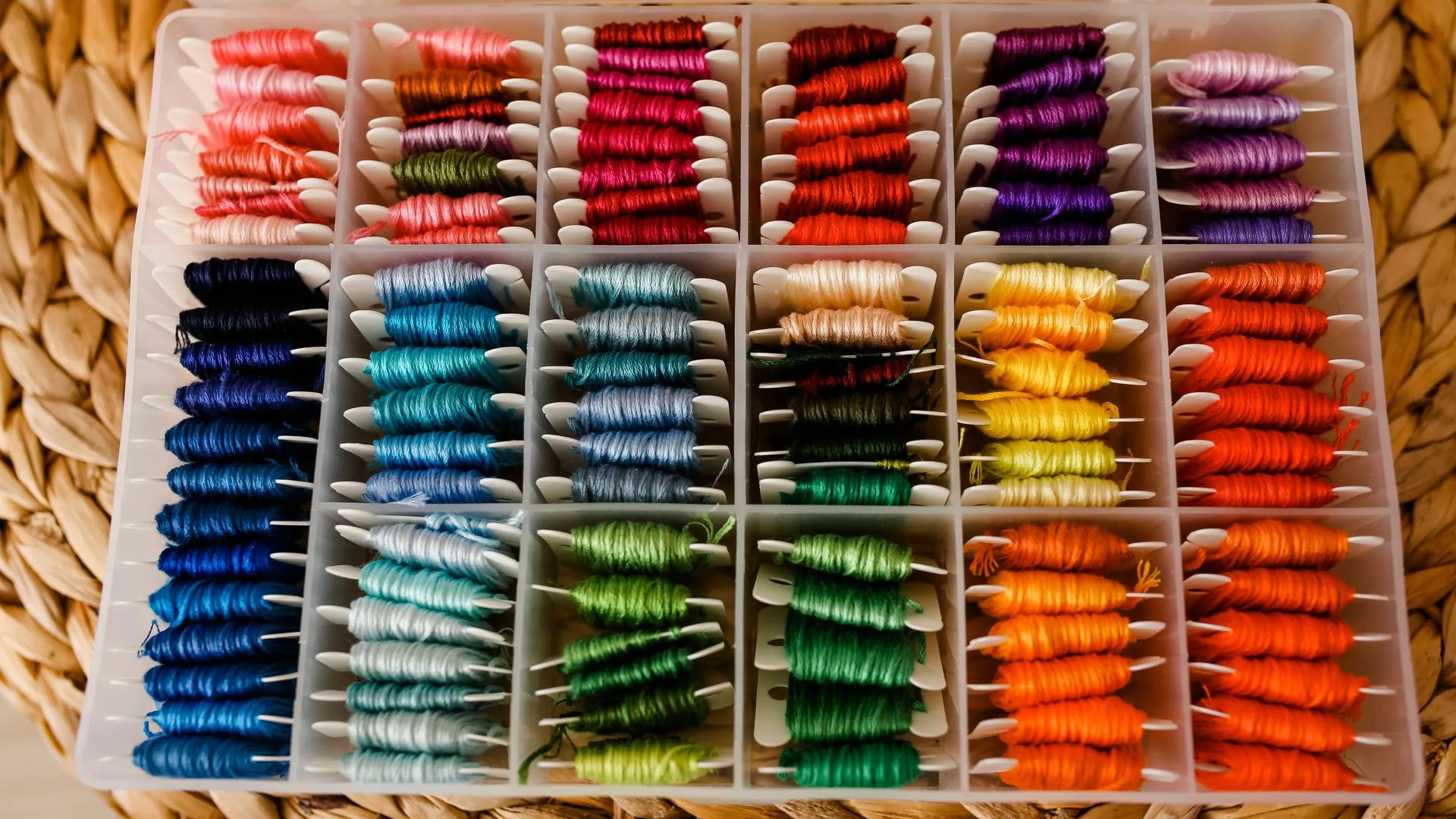
How to Keep Track of Your Thread Stash
Every stitcher's stash starts the same way: a few skeins left over from the first kit. A few projects later there are drawers of them, and the problem changes. It is no longer "do I have enough thread", it is "do I already have this one". Without a record, the answer is usually a third skein of black and a trip back to the shop for the one shade you were missing.
A stash only saves you money if you know what is in it. This guide covers how to keep a record that stays accurate, and how to check a pattern against it before you buy anything.
Label everything by brand and number
A record is only as good as the labels it points to. Every skein, bobbin or bag should carry its brand and shade number, because that is what patterns list and what shops sell. Colour names are not enough, because neighbouring shades often have near-identical ones: DMC 818 is Baby Pink and 819 is Baby Pink Light.
Wind a new skein onto a numbered bobbin when it arrives, or keep the paper band on it. There is more on bobbins, boxes and rings in how to organise your cross stitch threads.
Count skeins, not just colours
A list of the colours you own tells you whether to buy a shade. A count of the skeins tells you whether you have enough of it, which matters far more for the colours a pattern uses a lot of.
Partly used skeins are the awkward part. The simplest rule is to count a skein while there is enough left to be useful, and to stop counting it once it is down to a short length you would only use for a few stitches. Keep those ends together in one bag, so they are still there for small jobs without making the count look healthier than it is.
Choose a way to keep the record
There are three common ways, and the best one is whichever you will actually keep up to date.
A printed shade card or list. Tick the colours you own on a printed list of your brand's shades, and write the number of skeins beside each. It is quick to start and easy to take to a shop, but it gets messy as counts change, and it cannot tell you anything about a pattern on its own.
A spreadsheet. One row per shade, with brand, number, name and count. It is easy to sort and search, and you can paste in a pattern's thread list to compare. The work is in keeping it current, and it is awkward to update from your phone halfway through a session.
An app. A stash app holds the counts for you and can compare them against a pattern directly, so the shopping list works itself out. This is the least work once it is set up, provided entering a stash is quick. Nobody wants to type in two hundred skeins one by one.
Check a pattern before you buy
This is the payoff. Before you shop for a new project, go through its thread list and compare every colour against your stash. Three things can happen:
- You own enough. Nothing to buy.
- You own some, but not enough. Buy the difference, and one more if it is a main colour (see dye lots, below).
- You own none. Buy what the pattern needs.
For the middle case you need to know how many skeins the pattern needs, which many patterns do not tell you.
How many skeins a pattern needs
A standard skein of stranded cotton is 8 metres of six strands. If a pattern gives a length for each colour, divide it by 8 metres and round up. A colour that needs 9 metres needs two skeins, not one and a bit.
If it gives only stitch counts, the usual rough guide is that one skein covers about 1,500 to 1,800 full cross stitches on 14 count with two strands. Stitching with more strands, or on a coarser fabric, uses thread faster. There is more on the arithmetic in the fabric and thread calculator guide, and on strands in how many strands to use.
Allow for dye lots
Thread is dyed in batches, and two skeins of the same number from different batches can differ very slightly. Across a large area of one colour, that shows. So for the main colours of a big piece, buy all the skeins you need together, and one spare. Your existing stash is ideal for small areas, outlines and accents, where a slight difference will never be seen.
Keep it up to date
A stash record that is six months out of date is worse than none, because you trust it. Two habits keep it honest:
- Update it when you shop. Add new skeins as soon as they come home, before they go in a drawer.
- Update it when you finish a project. That is when skeins get used up, and when leftovers go back into the stash.
Different brands in one stash
Many stitchers end up with more than one brand. A pattern charted in DMC does not tell you whether the Anchor skeins in your drawer will do, so either keep one brand for each project or convert the pattern's colours to the brand you own before you check. The DMC thread conversion chart covers how brand equivalents work and where they are only close rather than exact.
Where HobbyTub fits
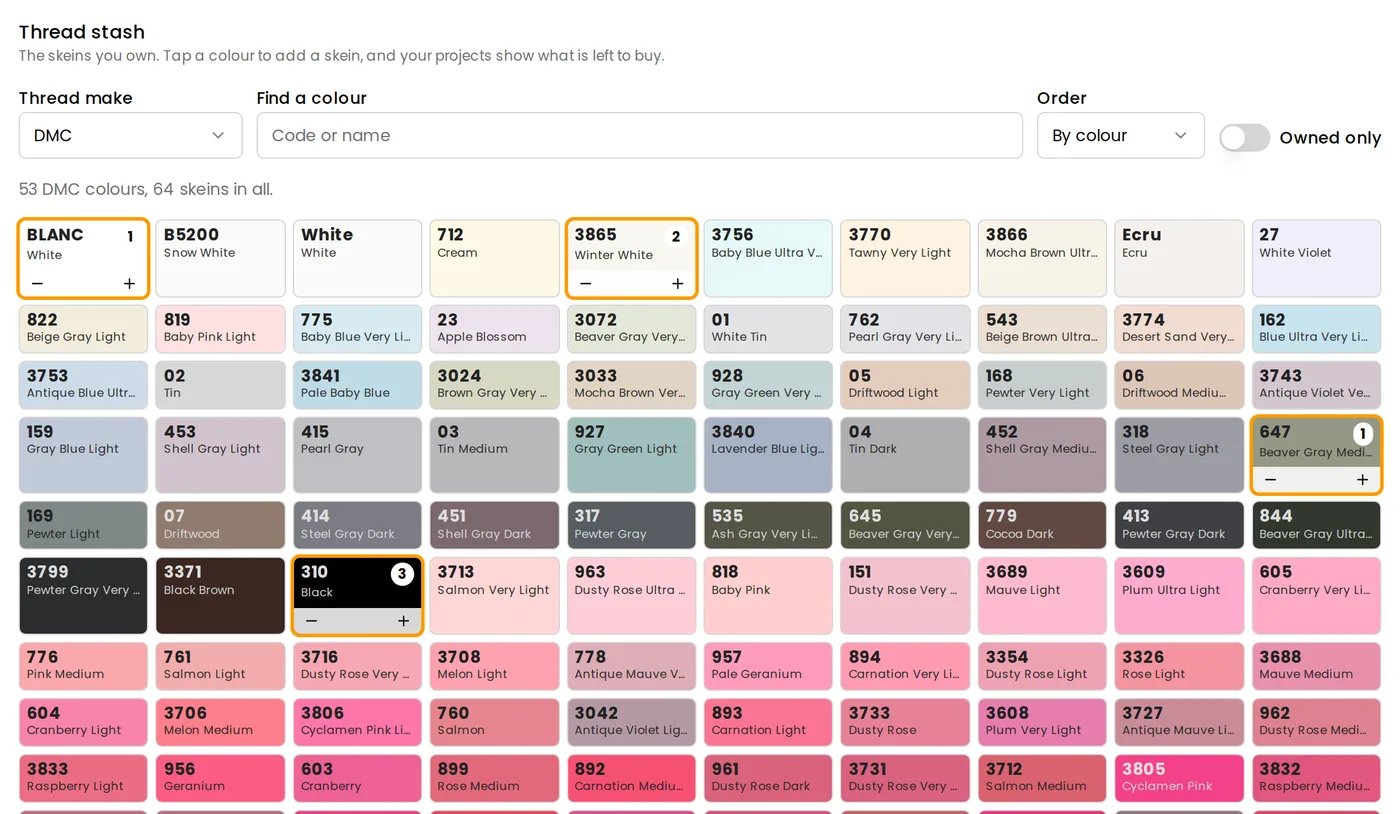
HobbyTub has a thread stash built in. Pick a brand and every one of its colours is laid out as a swatch, sorted by colour or by number. Tap a colour to add a skein, and use the minus and plus buttons to correct a count. The whole stash view shows everything you own across every brand.
Every colour in a pattern or a project tells you how many skeins it needs. Once you have a stash, that figure turns green where your stash covers it and amber with what is left to buy where it does not, and a project shows the skeins it needs beside the skeins you own. The skeins needed come from the thread length for each colour, which already allows for your fabric count and the strands the chart uses, divided by an 8 metre skein and rounded up. A line underneath says how many colours are short and how many skeins to buy.
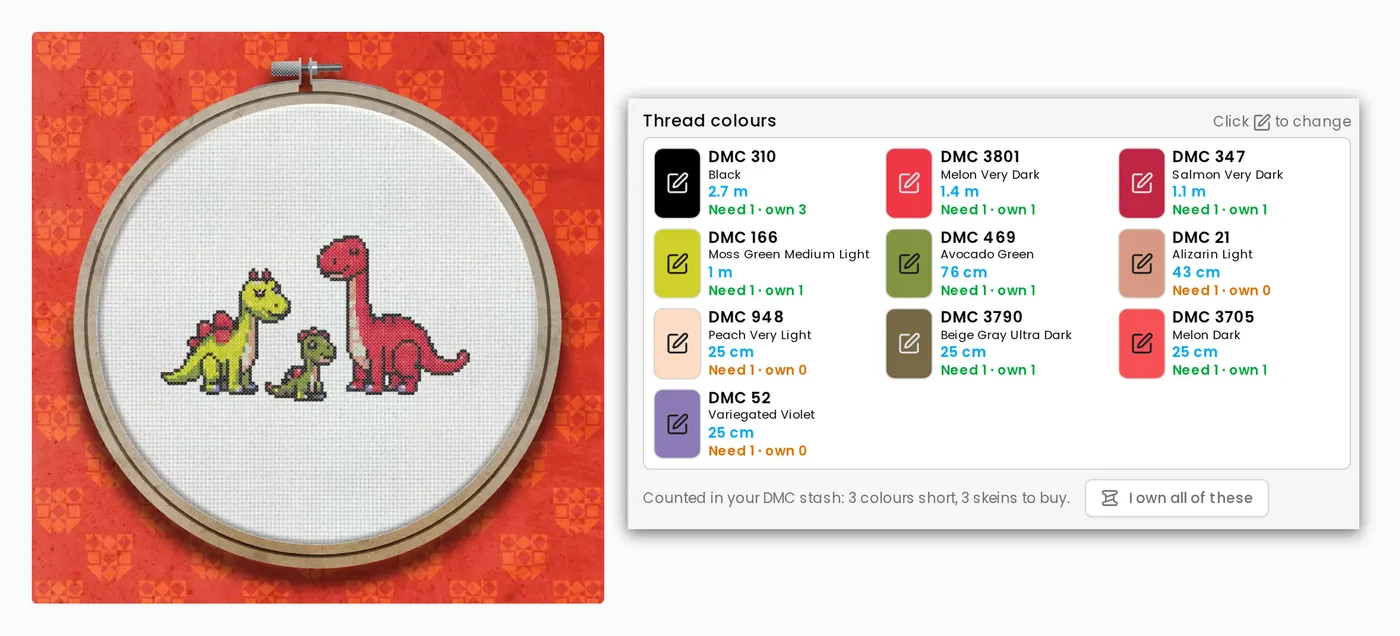
If you already have everything a pattern calls for, one button adds all of its colours to your stash at once. It asks first, and it never lowers a count you have already set. The stash does not count down as you stitch: it is what you own, and it changes when you change it.
There is more on how it works in the thread stash guide.