How to Read a Cross Stitch Pattern: Symbols, Colours and Grids
A cross stitch pattern can look intimidating the first time you open one. All those tiny squares, symbols and numbers seem like a secret code. The good news is that every chart follows the same handful of rules, and once you know them you can read almost any pattern. Let us walk through each part.
The chart is a grid
A cross stitch chart is simply a grid, and each square on the grid represents one stitch on your fabric. If the chart is 80 squares wide and 100 squares tall, your finished design will be 80 stitches wide and 100 stitches tall.
The grid does not tell you how big the finished piece will be in centimetres. That depends on your fabric count, which is a separate topic. For now, just remember that one square equals one stitch.
Colour blocks or symbols
Charts come in two main styles, and many patterns show both:
- Colour block charts fill each square with the colour of the thread you should use. These are easy to follow because the chart looks a little like the finished piece.
- Symbol charts put a small symbol in each square, such as a heart, a dot, a triangle or a letter. Each symbol stands for one thread colour.
Symbols matter more than you might expect. When two shades are very similar, a printed colour block can be hard to tell apart, but the symbols stay crisp and clear. Many stitchers prefer a chart that combines colour and symbol together for exactly this reason.
The colour key
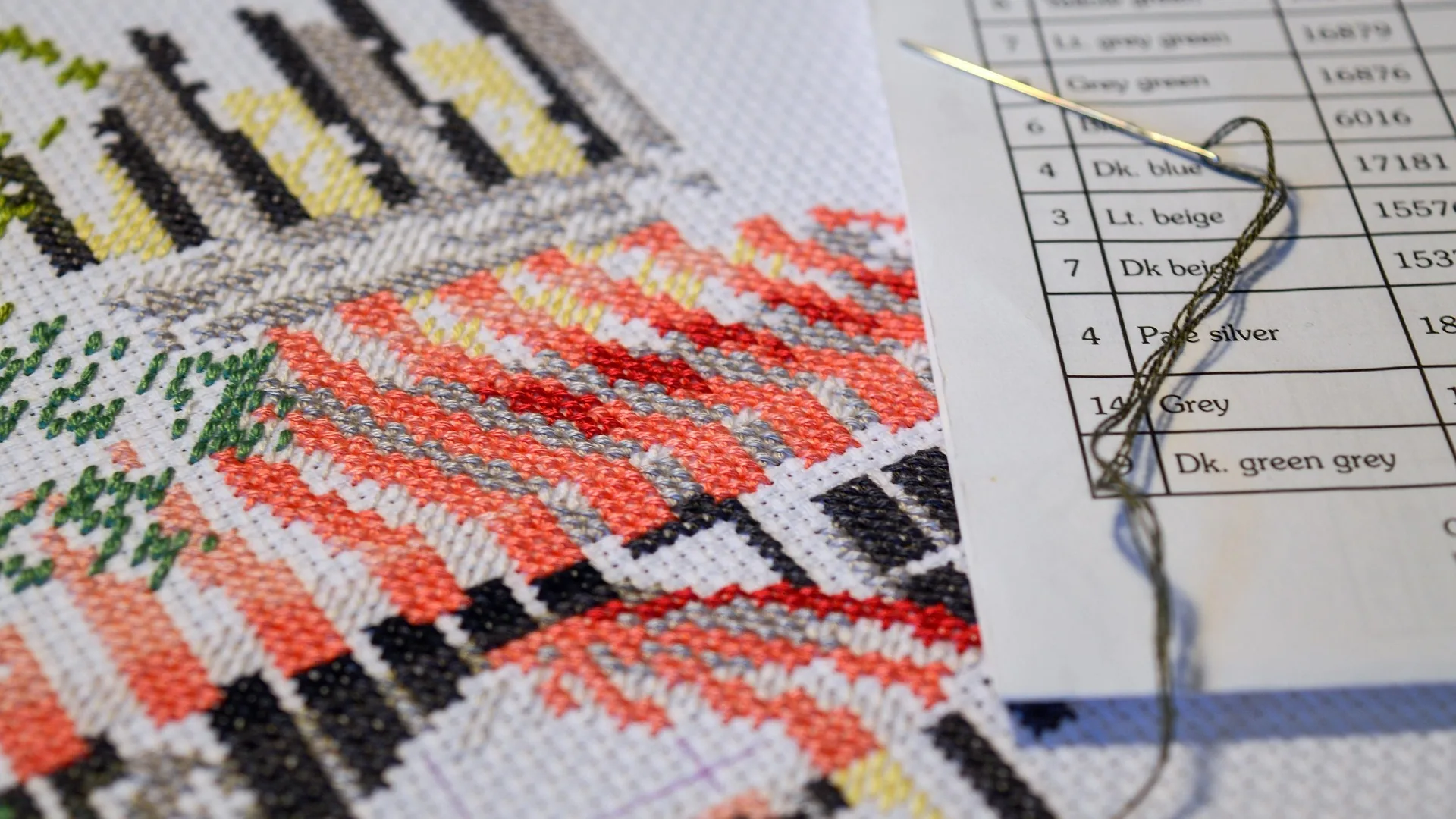
Every pattern comes with a key (sometimes called the legend or the floss list). This is the table that tells you what each symbol or colour means. For each one it usually lists:
- The symbol as it appears on the chart
- The thread brand and shade number, for example DMC 310 or Anchor 403
- A short colour name such as black or soft rose
- Sometimes the number of skeins you will need
The key is where you spend most of your time as a beginner. Keep it beside you and refer back to it whenever you meet a symbol you do not recognise. To learn more about the brands and numbers you will see here, read our guide to cross stitch thread brands.
Grid lines and the centre
Look closely and you will see that the grid has bold lines every ten squares. These heavier lines split the chart into blocks of ten, which makes counting far easier. Instead of counting square by square, you count in tens, just like reading a ruler.
Most charts also mark the centre of the design with small arrows or a cross along the edges. Finding the centre of both your chart and your fabric, then starting there, keeps your design neatly positioned so you never run off the edge of the fabric.
Whole stitches and fractional stitches
A plain filled square means a full cross stitch. Some patterns also use fractional stitches to soften curves and add detail. On the chart these appear as a symbol tucked into one corner or half of a square:
- A half stitch is a single diagonal line rather than a full X
- A quarter stitch fills one corner of a square
- A three-quarter stitch combines a half stitch with a quarter stitch
If fractional stitches are new to you, our post on fractional stitches explained walks through each one.
Backstitch and special stitches
Outlines, lettering and fine details are usually added with backstitch, shown on the chart as solid straight lines that sit on top of the grid rather than inside the squares. These lines are stitched last, once the cross stitches are done, and they give your work its crisp, finished edges. You can read more in our guide to what backstitch is and how to stitch it.
You may also see symbols for French knots, beads or other speciality stitches. These are always explained in the key, so check there whenever a symbol does not look like a normal stitch.
Where to start and how to keep your place
There is no single correct starting point, but a few habits help:
- Start from the centre so the design stays balanced on the fabric
- Work one colour or one small block at a time
- Tick off finished areas, or use a highlighter on a printed chart, so you always know where you are
- Count twice before committing to a long row
Losing your place is the most common frustration for beginners, so anything that helps you track progress is worth doing.
Reading your pattern on screen
If you stitch from a digital chart, keeping your place is even easier because you can zoom in, mark finished stitches and track your progress as you go. HobbyTub lets you follow a pattern stitch by stitch on any device and shades in your completed areas automatically, so you always know exactly where you are. You can browse our cross stitch patterns to see how it works.
Reading a chart becomes second nature after your first project. Take it one symbol at a time, keep the key close, and trust the grid. Once you can read a pattern comfortably, the whole craft opens up.